Universitas Gadjah Mada
  • GO SOUTH
    • ABOUT GO SOUTH
    • GO SOUTH 2025
    • THE SPEAKERS
    • THE CONVENER
    • PROGRAM SCHEDULE
    • CALL FOR ABSTRACTS
  • RESEARCH
    • DEMOCRACY, CONFLICT, AND SOCIAL INCLUSION
    • FOREIGN POLICIES, EMERGING POWERS, AND REGIONAL INTERSECTIONS
    • GLOBALISATION, DEVELOPMENT, AND ENVIRONMENT
    • SECURITY AND GLOBAL GOVERNANCE
  • ADVOCACY
    • STOP KILLER ROBOTS
    • DAMAI PANGKAL DAMAI
  • PUBLICATIONS
    • BOOKS
    • BOOK REVIEW
    • BRIEF
    • COMMENTARIES
    • GLOBAL SOUTH REVIEW
    • MONTHLY REVIEW
    • FORTNIGHTLY REVIEW
    • MONOGRAPH SERIES
    • ANNUAL REPORT
    • PROCEEDINGS
    • OPEN SUBMISSION
  • PROGRAMS
    • PROGRAMS
    • PAST EVENTS
  • ABOUT US
    • WHO WE ARE
    • OUR TEAM
    • IIS LIBRARY
    • PARTNERS
    • VACANCY
  • CONTACT
  • Beranda
  • Pos oleh
  • page. 24
Pos oleh :

iis.fisipol

IIS Fortnightly Review #9 | Edisi 1 – 15 September 2021

FeaturedNews Monday, 27 September 2021

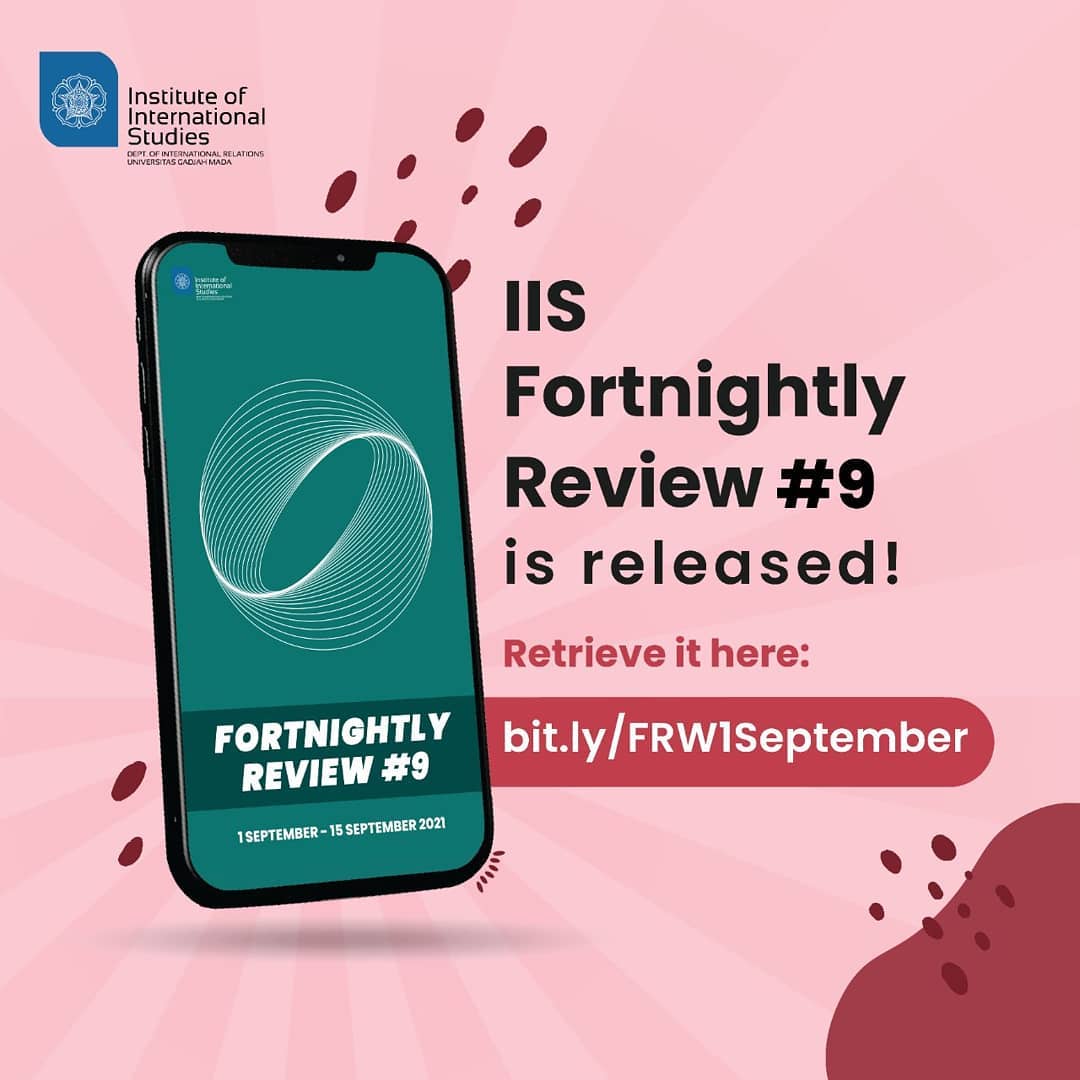
Our ninth edition of Fortnightly Review is out now! Articles featured in this edition are:

• Surviving Kabul’s Dramatic Takeover: Indonesia’s Moves to Prioritize the Safety of Indonesian Citizens and Embassy Transfer (F. Tarissa)
• Listen to the Afghans: But Which Afghan? (S. Al Murtadho)
• Politicizing Revenge Porn: How Myanmar Brutalizes Women Under the Guise of Democracy (F. Tarissa)
• Is Pandemic a “Black Swan” For ASEAN E-Commerce Industries? (Arrizal A.J.)

Access the review through https://simpan.ugm.ac.id/s/SwgFNOdOQt9uB0H
Annual Convention on Global South 2021 | International Order Beyond the Pandemic: Repositioning of the Global South

FeaturedNews Saturday, 25 September 2021

Greetings Go South enthusiast!

After three days of fruitful and engaging discussions in both seminars and panel sessions, we hereby conclude the Annual Convention on the Global South 2021. We hope that all participants could gain invaluable insights through this conference that would further the interest in the studies of the Global South.

As the convener of this conference, we would like to express our deepest gratitude to partners that have supported us in organizing this event. We would also appreciate the speakers, chairs, and moderators for their contributions in this conference. Lastly, we would also thank all participants for their spirited participations throughout conference sessions.

We are looking forward to see you again in the Annual Convention on the Global South 2022!

Commentaries : Indonesia is Not a Free Speech Country as Jokowi Said It Is

CommentariesNews Thursday, 23 September 2021

On 29 June 2021, President Joko ‘Jokowi’ Widodo asserted that Indonesia is a democratic country that champions free speech (Cabinet Secretariat of the Republic of Indonesia, 2021). The statement was given following the University of Indonesia’s Student Executive Body criticism of Jokowi, calling the President’ King of Lip Service.’ However, on Wednesday, 22 September 2021, Coordinating Minister for Maritime Affairs and Investment and Jokowi’s right-hand man, Luhut Binsar Pandjaitan, filed a police report against two human rights defenders, Haris Azhar and Fatia Maulidiyanti, for defamation and libel by using the draconian Information and Electronic Transactions Law, along with a civil lawsuit asking for an IDR100 million compensation. Luhut’s decision contradicts President Jokowi’s statement and, alas, proved that Indonesia is not a free speech country as Jokowi assumed it is.


How We Get Here: A Chronology

On 12 August 2021, a coalition of civil society organizations, which includes the Fatia-led Commission for the Disappeared and Victims of Violence (KontraS), published a report titled ‘The Political-Economy of Military Deployment in Papua.’ The report indicates a nexus between business operations, armed forces deployment, and conflict escalation in Papua. New police and military outposts were built around mining concessions, followed by the deployment of security personnel which, in turn, increased the number of violent conflicts in Intan Jaya Regency (KontraS, 2021). One of the companies involved is a gold mining company, Madinah Qurrata’ain Ltd. (PTMQ), a subsidiary of West Wits Mining (WWM).

In a project situated on the Derewo River, WWM yields thirty percent of its shares to Tobacom Del Mandiri Ltd. (TDM), a part of the Toba Sejahtera Group Ltd., with Luhut being one of the minority shareholders of Toba Sejahtera Group. On 20 August 2021, Haris, the Executive Director of Lokataru Law and Human Rights Office, invited Fatia as a guest speaker to his YouTube channel and discussed the report. On that occasion, Fatia mentioned that there is an indication that Luhut is involved in the business-military operations in Papua by virtue of his role as a minority shareholder of Toba Sejahtera Group.

On 26 August 2021, through his attorney, Juniver Girsang, Luhut subpoenaed Haris and Fatia. In the subpoena, Luhut asked Haris and Fatia to apologize for attacking Luhut’s reputation, character assassination, and spreading false news, and guarantee that in the future, they will not re-offend Luhut (Koalisi Bersihkan Indonesia, 2021). Luhut also threatened Haris and Fatia that if they fail to fulfill Luhut’s demands, further legal actions will be taken against them. However, both Haris and Fatia refused to apologize. Instead, they responded by emphasizing that the term used to describe Luhut’s involvement in the business-military operations in Papua, i.e., ‘indication,’ does not amount to character assassination, as declared by Luhut. Further, Haris and Fatia requested Luhut to counter their claims by providing more data and being more transparent about Luhut’s potential involvement, as suggested in the report.

Unsatisfied, Luhut sent another subpoena on 2 September 2021 before filing a police report today.


What Went Wrong: A Rights-Based Analysis

Luhut’s moves not only contradict Jokowi’s but also Indonesia’s commitment to respect, protect, and fulfill human rights, particularly the right to freedom of expression. As a State Party to the International Covenant on Civil and Political Rights (ICCPR), Indonesia is legally bound to respect, protect, and fulfill freedom of expression stipulated under Article 19. The operationalization of Article 19 is further enshrined under General Comment 34.

For instance, General Comment 34 acknowledges that public officials are legitimate subjects for criticism (United Nations, 2011). As policy-makers with almost unlimited resources at their disposal, public scrutiny serves as a means of check-and-balance to keep a tight rein on how the State is governed and, consequently, must be guaranteed. Therefore, “the mere fact that forms of expression are considered to be insulting to a public figure is not sufficient to justify the imposition of penalties (United Nations, 2011).”

Furthermore, under General Comment 34, all laws regarding defamation and the protection of the honor of public officials could potentially undermine freedom of expression and, subsequently, are incompatible with Article 19 of the ICCPR (United Nations, 2011). Hence, the Articles used by Luhut to charge Haris and Fatia, e.g., Article 27(3) (on the distribution of contents of affront) of the amended Information and Electronic Transactions Law and Articles 310 (on defamation) and 311 (on calumny) of the Criminal Code, should not be used due to their potential to create a climate of fear amongst citizens to exercise free speech (JPNN, 2021).

Indeed, Article 19 of the ICCPR allows for the limitation of freedom of expression. Nevertheless, such a restriction must follow two strict tests of necessity and proportionality, which Luhut failed to comply with (United Nations, 2011). The subpoena and the police report were unnecessary because Haris’ and Fatia’s criticism was aimed at a public official and based on research. The reasons for the former were already mentioned in the previous paragraphs. However, the rationales for the latter are more philosophical: research could only uncover truth partially. It is a way to verify the absolute truth. Suppose every study, due to its inability to unravel the holistic truth, would be criminalized. How many people will suffer from such practices and end up incapable of exercising their right to participate in academic activities or freely express their opinion?

Luhut also went overboard with the subpoena and the police report because they could harm Haris’ and Fatia’s mental and physical integrity. The harassment, intimidation, and stigmatization, as well as the potential of arrest, trial, or imprisonment, could be avoided had Luhut decided to answer Haris’ and Fatia’s criticism with data and transparency rather than criminalizing them.


How It Ought to Be: A Call to Action

Shreds of evidence have shown that Luhut’s decision to subpoenaed and filed a police report against two human rights defenders, Haris Azhar and Fatia Maulidiyanti, was groundless, uncalled for, and disproportionate. As such, I call upon the readers to urge:

  1. President Joko Widodo to ensure the respect, protection, and fulfillment of human rights, particularly the right to freedom of expression;
  2. Coordinating Minister Luhut Binsar Pandjaitan to withdraw the police report and respond to the claims made by Haris and Fatia by providing more data and transparency; and
  3. Greater Jakarta Metropolitan Regional Police to dismiss Luhut’s report.


Reference 

Cabinet Secretariat of the Republic of Indonesia. (2021). Criticism is Form of Freedom of Expression, President Jokowi Says. Retrieved on September 23, 2021, from https://setkab.go.id/en/criticism-is-form-of-freedom-of-expression-president-jokowi-says/

JPNN. (2021). Ini Alasan Luhut Menyeret Haris Azhar & Fatia ke Polisi. Retrieved on September 23, 2021, from https://www.jpnn.com/news/ini-alasan-luhut-menyeret-haris-azhar-fatia-ke-polisi?page=3

Koalisi Bersihkan Indonesia. (2021). PEJABAT KOK SUKA SOMASI WARGA [Internal note].

KontraS. (2021). Ekonomi-Politik Penempatan Militer di Papua: Kasus Intan Jaya. Retrieved on September 23, 2021, from https://kontras.org/wp-content/uploads/2021/08/FA-LAPORAN-PAPEDA-SPREAD.pdf

United Nations. (2011). General Comment No. 34. Retrieved on September 23, 2021, from https://www2.ohchr.org/english/bodies/hrc/docs/gc34.pdf


Writer : Aldo Kaligis

Annual Convention on Global South 2021 | International Order Beyond the Pandemic: Repositioning of the Global South

Uncategorized Tuesday, 31 August 2021

GO SOUTH 2021 is brought to you virtually with outstanding speakers!

Details of the conference are as follows:

Day 1 | Monday, 13 September 2021 / 08.30 AM (GMT+7)

Speakers:
• Vijay Prashad (Tricontinental Institute for Social Research)
• H.E Hassan Wirajuda (Ministry of Foreign Affairs of the Republic of Indonesia)
• Christian Reus-Smit (University of Queensland)
• Utz Johann Pape (World Bank)

Chairs:
• Luqman-nul Hakim (Universitas Gadjah Mada)
• Muhadi Sugiono (Universitas Gadjah Mada)


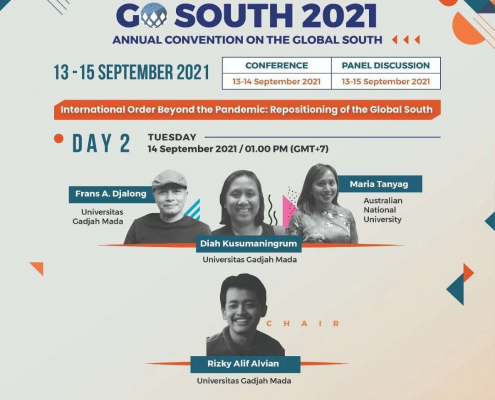
Day 2 | Tuesday, 14 September 2021 / 13.00 PM (GMT+7)

Speakers:
• Frans A. Djalong (Universitas Gadjah Mada)
• Diah Kusumaningrum (Universitas Gadjah Mada)
• Maria Tanyag (Australian National University)

Chair:
• Rizky Alif Alvian (Universitas Gadjah Mada)


This event is free of charge. However, a certificate of participation request is subject to a fee of IDR50,000.

For registration kindly visit:
https://bit.ly/RegistrasiGoSouth2021

IIS Fortnightly Review #8 | Edisi 15 – 31 Agustus 2021

FeaturedNews Tuesday, 31 August 2021

Our eight edition of Fortnightly Review is out now! Articles featured in this edition are:

• The Threatened Security in Afghanistan: The Taliban’s Politicisation and Objectification of the Afghan Women and Girls (J.D. Asmoro)
• Milk Tea Alliance: Youth Movements for The Better Future in Southeast Asia (M.S. Kemalsyah )
• Bipedalism of Global Tourism Trust Recovery: Review on Indonesian CHSE Certification and Vaccine Distribution (A.C.K. Putri)
• ‘Vulnerabilities Laid Bare’: The ILO Brief on Covid-19 and ASEAN Labour Maket (F. Tarissa)

Access the review through https://simpan.ugm.ac.id/s/jjSwVdIMabkIPb8

Beyond The Great Wall #16 : Memandang Cina dari Segi Kritis dan Krisis

News Monday, 30 August 2021

Jumat (27/08), Institute of International Studies, Universitas Gadjah Mada (IIS UGM) menyelenggarakan Forum Diskusi Beyond The Great Wall (BTGW) edisi #16 yang bertajuk “Memandang Cina Dari Segi Kritis dan Krisis”. Dalam kesempatan kali ini, IIS UGM mengundang 2 narasumber, yaitu Muhammad Zulfikar Rakhmat, Dosen serta Peneliti Hubungan Internasional Universitas Islam Indonesia dan Trystanto, Mahasiswa Ilmu Hubungan Internasional Universitas Gadjah Mada.

Sesi dibuka oleh Zulfikar yang membahas mengenai tulisannya yang berjudul “Neo-Gramscianisme dan Geliat Tiongkok di Indonesia”. Lewat materinya, Zulfikar mengajak audiens untuk memandang dinamika hubungan diantara Indonesia dan Cina lewat sudut pandang Neo- Gramscian. Pada sesi kedua, Trystanto memaparkan materinya yang berjudul “China’s Demographic Crisis : The Coming Collapse of China?”, dan membahas mengenai problematika demografis yang dapat mengancam perkembangan Cina di masa depan.

Seusai sesi pemaparan oleh kedua narasumber, kegiatan ditutup dengan sesi diskusi yang berlangsung dengan kondusif.

Cangkir Teh #4 : Memahami Konsep Settler Colonialism : Studi Kasus Israel – Palestina

News Monday, 30 August 2021

Selasa (24/08), Institute of International Studies Universitas Gadjah Mada (IIS UGM) melangsungkan diskusi Cangkir Teh edisi keempat. Edisi kali ini mendiskusikan dan membedah lebih lanjut mengenai Konsep Settler Colonialism dengan menggunakan Studi Kasus Israel-Palestina. Dalam kesempatan ini, IIS UGM mengundang Kishino Bawono, Dosen Ilmu Hubungan Internasional Universitas Katolik Parahyangan dengan spesialisasi studi Timur Tengah, berfokus pada isu Israel-Palestina. Dalam materinya, Kishino memaparkan mengenai latar belakang dari settler colonialism, perbedaan dan persamaannya dengan classical colonialism, kemudian masuk ke pembahasan studi kasus yakni memahami Israel sebagai sebuah settle colonial state. Terakhir, Kishino juga membahas hambatan yang ada untuk menyelesaikan isu settler colonialism di Israel-Palestina ini.

Kegiatan kemudian dilanjutkan dengan diskusi yang berlangsung dengan kondusif dan peserta diskusi yang partisipatif.

Cangkir Teh | Memahami Konsep Settler Colonialism: Studi Kasus Israel-Palestina

FeaturedNews Thursday, 19 August 2021

Settler Colonialism atau kolonialisme pemukim adalah suatu bentuk penjajahan yang bertujuan untuk menggantikan masyarakat asli dari wilayah jajahan dengan masyarakat pemukim atau penjajah. Di dalam jenis kolonialisme ini, masyarakat asli tidak hanya terancam untuk kehilangan wilayah, namun juga cara kehidupan dan juga identitas yang telah dimiliki turun-temurun.

Berbagai contoh kolonialisme pemukim masih ada dan nyata hingga kini. Salah satunya adalah di Palestina, di mana pengusiran penduduk asli Palestina dari Tepi Barat masih terus terjadi dan sempat meletus menjadi suatu krisis internasional pada Mei lalu. Di bawah kolonialisme pemukim Israel, penduduk asli Palestina menghadapi berbagai ancaman eksistensial yang kerap kali difasilitasi oleh Israel.


Diskusi Cangkir Teh : Memahami Konsep Settler Colonialism: Studi Kasus Israel-Palestina akan diselenggarakan pada :

Tanggal : Selasa, 24 Agustus 2021
Waktu : 13.00 – 14.30 WIB
Tempat: Zoom Meeting

Pembicara:
• Kishino Bawono, Dosen Hubungan Internasional Universitas Katolik Parahyangan

Moderator:
• Cut Intan Auliannisa Isma, Program Manager Institute of International Studies (IIS) HI UGM

Registrasi dapat dilakukan melalui tautan bit.ly/CangkirTeh4


IIS Fortnightly Review #7 | Edisi 1 – 14 Agustus 2021

IIS Fortnightly ReviewNews Thursday, 19 August 2021

Our seventh edition of Fortnightly Review is out now! Articles featured in this edition are:

• Beyond Beijing-Jakarta: China’s Expanding Economic Partnerships with Indonesia’s Provinces (F. Tarissa)
• ‘We Dont’t Want This Anymore’: Guatemalans Strike Against Corruption Amidst the Pandemic (F. Tarissa)
• The Aftermath of South Africa’s Recent Unrest on Economic Recovery (F. Tarissa)
• Vaccine Passports Politics Amidst an Increasingly Polarized World (R.W Pradipta)

Access the review through https://simpan.ugm.ac.id/s/VnOFvOIgVAtGMS5

Commentaries : Signifikansi Traktat Pelarangan Senjata Nuklir bagi Perdamaian Dunia dan Urgensi Indonesia

CommentariesNews Monday, 9 August 2021

Traktat Pelarangan Senjata Nuklir (Treaty on the Prohibition on Nuclear Weapons/TPNW) pertama kali diadopsi pada tahun 7 Juli 2017 untuk menjawab kebutuhan akan sebuah instrumen hukum yang dapat mengatur kepemilikan dan pengembangan senjata nuklir bagi negara-negara anggotanya. Berangkat dari kekhawatiran akan terulangnya tragedi kemanusiaan Hiroshima dan Nagasaki di tanggal 6 dan 9 Agustus 1945, TPNW diharapkan dapat menghentikan segala aktivitas yang berhubungan dengan senjata nuklir dan bermuara pada pemusnahan secara total.

Cara TPNW Bekerja

TPNW memiliki karakter yang unik jika dibandingkan dengan konvensi-konvensi pengaturan senjata nuklir yang telah ada sebelumnya, seperti Non-Proliferation Treaty (1968) dan konvensi tentang kawasan bebas-nuklir lainnya. Traktat ini tidak hanya melarang pengembangan, uji coba, pertukaran, penggunaan, dan penyimpanan senjata nuklir bagi negara anggota, tapi juga melarang mereka untuk menjadi ‘host’ bagi negara lain untuk melakukan aktivitas serupa. Selain itu, TPNW juga mengatur kewajiban negara membantu korban yang disebabkan oleh aktivitas nuklir, termasuk di antaranya memberi jaminan kesehatan, psikologis, dan tunjangan ekonomi. 

Secara teknis, negara-negara dapat memilih untuk menghilangkan kepemilikan dan keterlibatan mereka dalam aktivitas senjata nuklir sebelum meratifikasi TPNW atau secara berangsur dan konsisten mengurangi aktivitas tersebut dalam kurun waktu yang telah disepakati. Setelah negara-negara tersebut berhasil melucuti fasilitas senjata nuklirnya, International Atomic Energy Agency (IAEA) akan memberlakukan pengamanan ketat guna menjamin benar-benar tidak ada lagi fasilitas yang tersisa untuk digunakan di masa depan.

Secara prinsip, TPNW bekerja dengan cara kolektif melalui pemberian stigma pada senjata nuklir dan pihak-pihak yang melakukan aktivitas terkait. Sejarah menunjukkan bahwa senjata-senjata yang telah mendapat larangan seiring berjalannya waktu akan semakin kehilangan status politisnya – membuat kebutuhan akan senjata tersebut semakin menurun, perusahaan persenjataan semakin sulit mendapat bantuan dana untuk pengadaan senjata nuklir, dan para investor juga harus berpikir ulang untuk berinvestasi pada sektor tersebut karena ada reputasi baik yang menjadi taruhan. Dalam jangka panjang, berkurangnya signifikansi kepemilikan senjata nuklir secara global dapat mewujudkan cita-cita diciptakannya TPNW, yakni pemusnahan total senjata nuklir yang mengancam perdamaian dunia.

Sifat kolektif TPNW tidak hanya terletak pada stigmatisasi senjata nuklir, tapi juga pada efektivitas pemberlakuannya. TPNW hanya dapat secara hukum mengikat negara-negara yang telah melakukan ratifikasi, terlepas traktat itu sendiri telah resmi berlaku sejak tanggal 21 Januari 2021. Sehingga, meskipun terhitung hari ini (9/8/2021) sudah ada 55 negara yang meratifikasi, butir-butir perjanjian yang termuat di dalam TPNW belum bisa berlaku secara menyeluruh. Hal inilah yang kemudian mendorong urgensi diratifikasinya TPNW oleh lebih banyak negara, terutama mereka yang memiliki kapasitas senjata nuklir yang besar dan secara aktif mengembangkannya, seperti Amerika Serikat, Rusia, Cina, Perancis, dan Inggris. 

Namun, bukan berarti dukungan dari negara-negara yang tidak memiliki kapasitas serupa tidaklah penting. Senjata nuklir merupakan bencana yang dapat menimpa semua pihak tanpa diskriminasi. Dampak yang disebabkan oleh senjata nuklir tidak hanya memilih mereka yang mengibarkan perang, tapi juga mencakup rakyat sipil yang tidak bersalah dan lingkungan untuk jangka waktu yang panjang. Kompetisi pengembangan senjata nuklir juga mengakibatkan senjata ini semakin diminati sebagai strategi pertahanan negara – seperti yang pernah diungkapkan oleh PM Inggris, Boris Johnson, ketika mengumumkan keputusan untuk menambah hulu ledak nuklir Inggris. Sehingga, bukan tidak mungkin senjata ini akan diluncurkan jika perang terjadi di masa depan. Bukankah sejarah sudah membuktikannya?

Di samping itu, dukungan secara masif dari berbagai negara dapat menguatkan relevansi dari nilai-nilai yang terkandung dalam TPNW. Negara yang sebelumnya percaya bahwa senjata nuklir merupakan solusi pertahanan yang baik dapat berubah pikiran setelah menyaksikan banyaknya negara yang memutuskan untuk meratifikasi TPNW. Bukan hanya sekedar tidak lagi melihat senjata nuklir sebagai solusi, negara-negara ini juga dapat berempati kepada pihak-pihak yang ingin bebas dari momok tersebut dan merasa turut bertanggung jawab atas kemaslahatan orang banyak.  Hal ini terbukti saat Perancis dan Cina bergabung ke dalam Non-Proliferation Treaty setelah beberapa dekade sebelumnya menunjukkan pertentangan.

Peran Indonesia

Indonesia tidaklah terkecuali. Indonesia merupakan salah satu saksi sejarah dan bagian dari sekelompok negara yang paling awal membubuhkan tanda tangan untuk TPNW pada tanggal 20 September 2017. Namun, hingga saat ini tindakan tersebut belum dilanjutkan oleh ratifikasi. 

Pelucutan senjata nuklir seharusnya menjadi salah satu perhatian dan komponen penting dari politik luar negeri Indonesia yang seyogianya diikuti dengan tindakan nyata, yakni ratifikasi. Ratifikasi oleh Indonesia memiliki nilai dan pengaruh yang sangat signifikan bagi TPNW – meskipun saat ini Indonesia belum memiliki kapasitas senjata nuklir. Indonesia merupakan negara dengan populasi terbesar ke-4 di dunia dengan jumlah populasi sebanyak 260 juta jiwa. Jika diakumulasikan dengan total 1,08 miliar warga yang dinaungi oleh 55 negara peratifikasi TPNW lainnya, maka buah ratifikasi Indonesia dapat melindungi 1,34 miliar manusia dari ancaman perang nuklir di masa depan. 

Indonesia juga terlibat aktif dalam berbagai organisasi internasional bergengsi, termasuk di antaranya G20 dan Southeast Asia Nuclear Weapon-Free Zone (SEANWFEZ). Bergabungnya Indonesia ke dalam TPNW dapat mempengaruhi negara-negara lain untuk turut mengambil langkah serupa. Sebagai anggota SEANWFEZ sendiri, ratifikasi TPNW dapat dilihat sebagai upaya perluasan global dari tujuan awal dibentuknya organisasi tersebut, yakni mewujudkan Asia Tenggara sebagai kawasan bebas nuklir. Terlebih, jika dilihat dari perspektif keamanan, Indonesia bukanlah negara yang dapat duduk tenang bila penggunaan senjata nuklir menjadi lumrah di masa depan. Indonesia rawan akan konflik perbatasan serta aktivitas kejahatan transnasional. Alam Indonesia yang luas dan kaya juga akan sangat terdampak oleh segala bentuk aktivitas senjata nuklir.

Pada hakikatnya, meratifikasi TPNW bukanlah sekedar tentang kewajiban Indonesia untuk menjaga ketertiban dunia dan perdamaian abadi seperti yang telah diamanatkan oleh konstitusi UUD 1945, tapi juga merupakan bentuk tuntutan akan hak seluruh warga negara atas ruang hidup yang aman dan bebas dari ancaman eksistensial hingga generasi-generasi yang akan datang.

Referensi


Booth, W. (2021). Boris Johnson’s vision for post-brexit ‘Global Britain’ includes more nuclear weapons. Washington Post. https://www.nytimes.com/2020/10/25/world/americas/nuclear-weapons-prohibition-treaty.html


Gladstone, R. (2020). Treaty to prohibit nuclear weapons passes important threshold. The New York Times. https://www.nytimes.com/2020/10/25/world/americas/nuclear-weapons-prohibition-treaty.html


How the treaty works. (2021). ICAN. https://www.icanw.org/how_the_tpnw_works


Lovold, M. (2021). Why does the nuclear ban treaty matter. International Committee of the Red Cross. https://www.icrc.org/en/document/why-nuclear-ban-treaty-matters


Marin-Bosch, M.  A nuclear weapons-free world: is it achievable? United Nations. https://www.un.org/en/chronicle/article/nuclear-weapons-free-world-it-achievable


Penulis : Cut Intan Auliannisa Isma

1…2223242526…51
Universitas Gadjah Mada

Faculty of Social and Political Sciences
Universitas Gadjah Mada
Jl. Sosio-Justisia No.1 Bulaksumur
Yogyakarta 55281, Indonesia

Phone:
+62-274-563362 Ext. 115

E-Mail:
iis.fisipol@ugm.ac.id

© Universitas Gadjah Mada

KEBIJAKAN PRIVASI/PRIVACY POLICY