
On July 9th – 11th, 2024, the Association for Asian Studies and Universitas Gadjah Mada organized the AAS-in-Asia Conference 2024 themed Global Asias: Latent Histories, Manifest Impacts in Yogyakarta, Indonesia. At this conference, the Institute of International Studies, Department of International Relations, Universitas Gadjah Mada (IIS UGM), collaborating with Murdoch University and RUJAK Center for Urban Studies, presented a panel session titled “Contesting Loss for Indonesian Communities in Climate-Crisis” on Thursday, 11th July 2024. The panel session was held in Room 310, 3rd Floor of the R. Soegondo Building, Faculty of Cultural Sciences, Universitas Gadjah Mada. It discussed the consortium’s ongoing research project under the KONEKSI-DFAT research grant regarding Indonesia’s Loss and Damage (L&D) framework and how communities can be involved in decision-making.
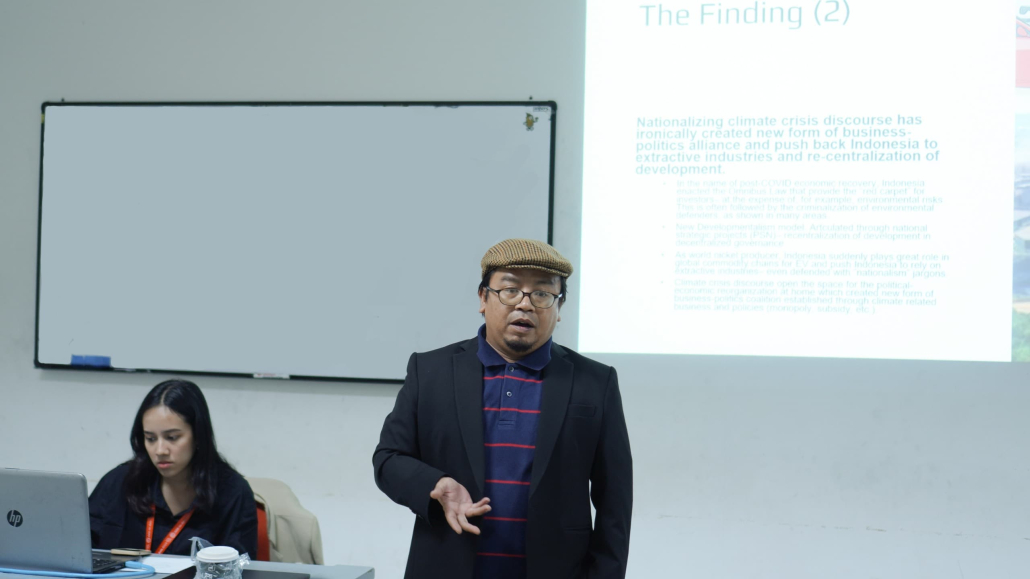
The panel session began with a presentation on “L&D and Political-Economy of Sustainable Development in Indonesia” by Dr. Luqman-nul Hakim, the Director of the Institute of International Studies. In his presentation, Dr. Luqman highlighted that ineffective climate governance poses significant threats to the welfare and safety of the Indonesian community. The inadequacy to handle the Loss and Damage issue can be seen through how adaptive approach to climate change still prioritizes economic gains rather than the protection of human rights. In the international sphere, the effectiveness of Indonesia’s climate diplomacy on L&D is compromised when there is a lack of domestic legitimacy and inadequate credibility globally.
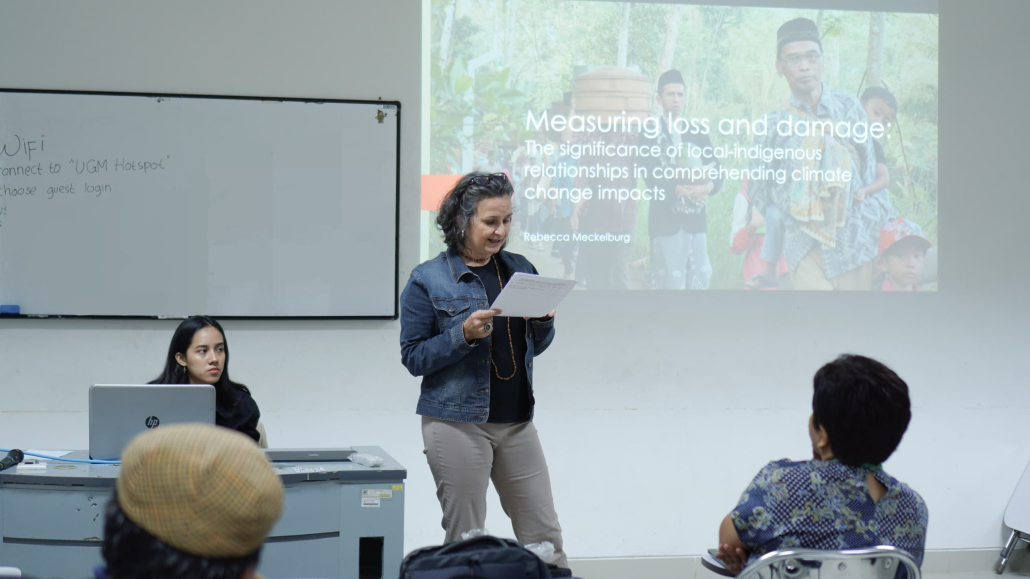
The second presentation was delivered by Dr. Rebecca Meckelburg, titled “Measuring Loss and Damage: The Significance of Local-Indigenous Relationships in Comprehending Climate Change Impacts.” This presentation is based on ethnographic field-research findings in Banyusidi. One of the major findings underscores the need to develop a ‘common language’ for discussing climate change, as there are specific local terms used by local communities to talk about climate change. Therefore, it is essential to incorporate local knowledge to identify climate change and its impacts.
The panel session continued with the third presentation from the RUJAK Center for Urban Studies by Dr. Dian Tri Irawaty, who explained the “Urban Findings Report” based on field research findings in the Penjaringan sub-district. Dr. Dian underscored that climate change has worsened the economic, socio-political, and environmental problems. The main measurable consequences communities have faced include income reduction and increased expenses. Meanwhile, the non-measurable consequences include physical or mental health, and conflict among community members in Penjaringan.
In the last presentation, Dr. Agung Wardana from Universitas Gadjah Mada presented the L&D in Small Islands with the case study of Pari Island. Dr. Agung narrowed down the focus to the experience of Pari Island, as a sub-national small island whose inhabitants recently launched a climate litigation through the Asmania et al. vs Holcim case. In his presentation, he analyzed the structural factors that have influenced the climate-affected community in the Global South to decide to engage in transnational climate litigation. The panel session was then followed by a Q & A Session.
Written by: Anggita Fitri Ayu Lestari
Editor: Ni Made Diah Apsari Dewi & Nabilah Nur Abiyanti
