[googlepdf url=”https://iis.fisipol.ugm.ac.id/wp-content/uploads/sites/720/2024/10/FR-81-Layout-1.pdf” download=”Download” width=”100%” height=”600″]

[googlepdf url=”https://iis.fisipol.ugm.ac.id/wp-content/uploads/sites/720/2024/10/FR-81-Layout-1.pdf” download=”Download” width=”100%” height=”600″]
[googlepdf url=”https://iis.fisipol.ugm.ac.id/wp-content/uploads/sites/720/2024/10/FR-80-Layout-copy.pdf” download=”Download” width=”100%” height=”600″]
[googlepdf url=”https://iis.fisipol.ugm.ac.id/wp-content/uploads/sites/720/2024/09/FR-79.pdf” download=”Download” width=”100%” height=”600″]

Yogyakarta, 10 Agustus 2024 – Institute of International Studies, Universitas Gadjah Mada (IIS UGM) menyelenggarakan kegiatan expert panel bersama Circular School Program Partnership: Indonesia Green Principal Award (IGPA) dengan tema Strategi Membangun Niche dalam Transisi Sekolah Sirkular.
Terdapat dua tujuan yang ingin dicapai melalui kegiatan expert panel ini. Pertama, memetakan potensi, tantangan, dan strategi pembangunan niche dalam pendidikan ekonomi sirkular. Kedua, upaya co-creation perumusan strategi, intervensi dan langkah antisipasi dalam pengembangan inisiatif sekolah sirkular. Expert panel ini merupakan salah satu rangkaian dari proyek penelitian ‘Advancing Circular Education for Sustainable Transformation (ACEST): Strategi Membangun Niche dalam Transisi Sekolah Sirkular,’ yang didanai oleh Direktorat Jenderal Pendidikan Tinggi Kementerian Pendidikan dan Kebudayaan Republik Indonesia. Kegiatan dipandu oleh Wendi Wiliyanto selaku Master of Ceremony dengan empat rangkaian aktivitas.
Pertama, expert panel dibuka dengan kata sambutan oleh Dr. Luqman-nul Hakim, Direktur IIS UGM. “Mudah-mudahan, bukan hanya kita saling bertukar pikiran, tetapi kegiatan ini juga dapat menjadi ruang silaturahmi dan momen yang fun bagi kita semua. Semoga acara ini berjalan lancar dan kita bisa memperoleh pengetahuan dan pertemanan,” ucap Dr. Luqman-nul Hakim.
Kemudian, kegiatan dilanjutkan dengan sambutan oleh Dr. Maharani Hapsari, selaku ketua peneliti proyek ini. Dalam sambutannya, Dr. Maharani Hapsari menekankan keinginan besar tim riset untuk belajar banyak dari Bapak/Ibu panelis dalam membangun keterampilan leadership (kepemimpinan) karena masih banyak agenda yang perlu diperbaiki dalam level universitas, utamanya UGM. “Melaksanakan riset sirkular ekonomi ini adalah upaya kami untuk mendukung kebijakan-kebijakan di level universitas juga,” kata Dr. Maharani Hapsari.
Terakhir, sambutan disampaikan oleh Dr. Junita Widiati Arfani, selaku koordinator Circular School Program Partnership. “Sebagai pihak yang mendukung acara ini, semoga kita bisa berkumpul dan berbagi wawasan berharga. Hari ini kita akan mendengarkan para ahli di bidang sekolah sirkular yang dianggap sudah menunjukkan kepemimpinan dan inovasi. Dan terimakasih Bapak/Ibu sekalian sudah siap berbagi pengetahuan serta menjawab berbagai pertanyaan seputar pengalaman dan visi ke depan Bapak/Ibu,” ucap Dr. Junita Widiati Arfani.
Kedua, kegiatan dilanjutkan dengan pengenalan proyek riset dan permainan sederhana yang dipandu oleh Dr. Suci Lestari Yuana dan Dr. Ririn Tri Nurhayati. Pemaparan materi berfokus pada latar belakang, rumusan masalah, tujuan penelitian, dan maksud keterlibatan partisipan dalam kegiatan expert panel tersebut.
Ketiga, kegiatan Diskusi Kelompok Terfokus sebagai inti agenda dimulai. Objektif utama dalam kegiatan ini berorientasi pada upaya pemetaan inovasi dalam transformasi sekolah sirkular. Terdapat dua topik besar yang menjadi basis diskusi: 1) eksplorasi posisi local practices yang tumbuh dan berkembang di sekolah melalui Transformative Pathway for Mundane Circular Economy dan 2) petualangan proses pembelajaran sekolah dalam implementasi ekonomi sirkular serta ekspektasi dan visi transformasi sekolah sirkular di masa depan melalui Strategic Niche Management.
Keempat, Bapak/Ibu partisipan diundang untuk bermain simulasi debat dengan topik implementasi kebijakan ekonomi sirkular dalam ranah kehidupan sehari-hari. Kegiatan ini dipandu oleh Laras Kineta. Kegiatan berjalan lancar dan menyenangkan. Kegiatan ini berhasil menggambarkan bahwa transformasi tidak selalu dimulai dari tingkat pemerintah; seringkali, perubahan juga bisa berasal dari level lokal.
Simak lebih lanjut laporan kegiatan melalui file berikut.
[googlepdf url=”https://iis.fisipol.ugm.ac.id/wp-content/uploads/sites/720/2024/09/Final-Version-1-1.pdf” download=”Download” width=”100%” height=”600″]
[googlepdf url=”https://iis.fisipol.ugm.ac.id/wp-content/uploads/sites/720/2024/09/FR-78-Layout-copy.pdf” download=”Download” width=”100%” height=”600″]
[googlepdf url=”https://iis.fisipol.ugm.ac.id/wp-content/uploads/sites/720/2024/08/FR-77-Layout-copy.pdf” download=”Download” width=”100%” height=”600″]
[googlepdf url=”https://iis.fisipol.ugm.ac.id/wp-content/uploads/sites/720/2024/08/FR-76-Layout.pdf” download=”Download” width=”100%” height=”600″]

On July 9th – 11th, 2024, the Association for Asian Studies and Universitas Gadjah Mada organized the AAS-in-Asia Conference 2024 themed Global Asias: Latent Histories, Manifest Impacts in Yogyakarta, Indonesia. At this conference, the Institute of International Studies, Department of International Relations, Universitas Gadjah Mada (IIS UGM), collaborating with Murdoch University and RUJAK Center for Urban Studies, presented a panel session titled “Contesting Loss for Indonesian Communities in Climate-Crisis” on Thursday, 11th July 2024. The panel session was held in Room 310, 3rd Floor of the R. Soegondo Building, Faculty of Cultural Sciences, Universitas Gadjah Mada. It discussed the consortium’s ongoing research project under the KONEKSI-DFAT research grant regarding Indonesia’s Loss and Damage (L&D) framework and how communities can be involved in decision-making.
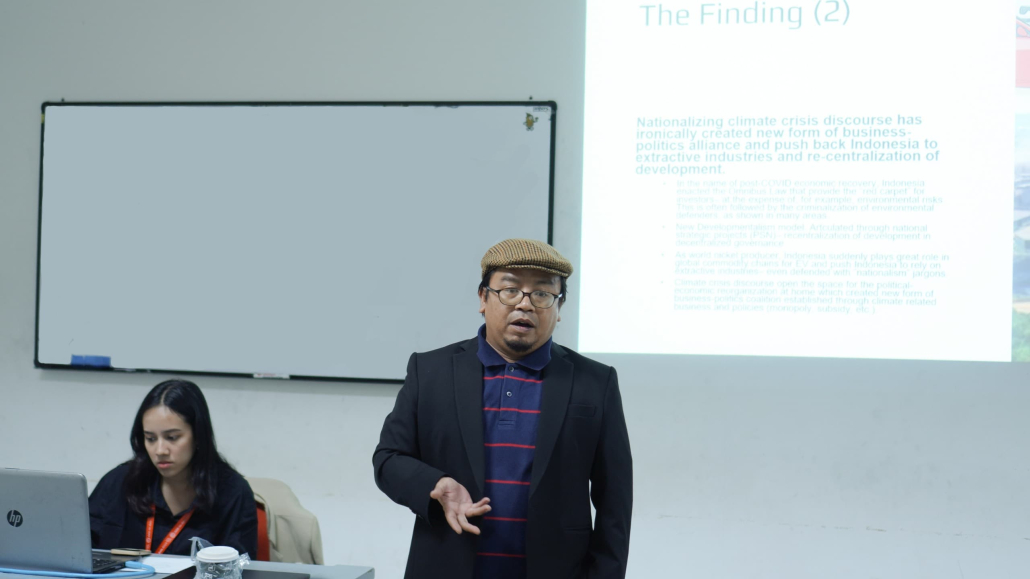
The panel session began with a presentation on “L&D and Political-Economy of Sustainable Development in Indonesia” by Dr. Luqman-nul Hakim, the Director of the Institute of International Studies. In his presentation, Dr. Luqman highlighted that ineffective climate governance poses significant threats to the welfare and safety of the Indonesian community. The inadequacy to handle the Loss and Damage issue can be seen through how adaptive approach to climate change still prioritizes economic gains rather than the protection of human rights. In the international sphere, the effectiveness of Indonesia’s climate diplomacy on L&D is compromised when there is a lack of domestic legitimacy and inadequate credibility globally.
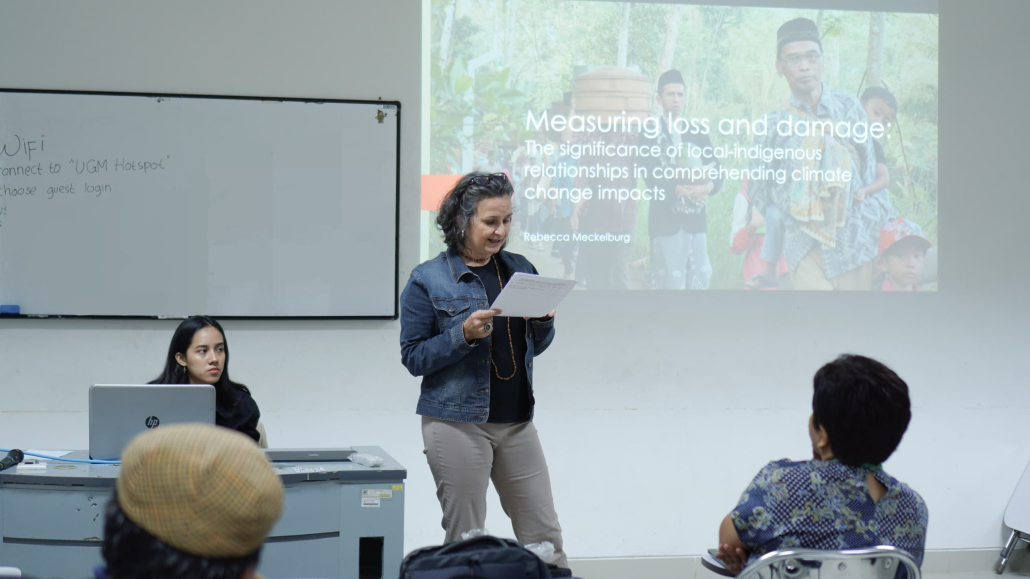
The second presentation was delivered by Dr. Rebecca Meckelburg, titled “Measuring Loss and Damage: The Significance of Local-Indigenous Relationships in Comprehending Climate Change Impacts.” This presentation is based on ethnographic field-research findings in Banyusidi. One of the major findings underscores the need to develop a ‘common language’ for discussing climate change, as there are specific local terms used by local communities to talk about climate change. Therefore, it is essential to incorporate local knowledge to identify climate change and its impacts.
The panel session continued with the third presentation from the RUJAK Center for Urban Studies by Dr. Dian Tri Irawaty, who explained the “Urban Findings Report” based on field research findings in the Penjaringan sub-district. Dr. Dian underscored that climate change has worsened the economic, socio-political, and environmental problems. The main measurable consequences communities have faced include income reduction and increased expenses. Meanwhile, the non-measurable consequences include physical or mental health, and conflict among community members in Penjaringan.
In the last presentation, Dr. Agung Wardana from Universitas Gadjah Mada presented the L&D in Small Islands with the case study of Pari Island. Dr. Agung narrowed down the focus to the experience of Pari Island, as a sub-national small island whose inhabitants recently launched a climate litigation through the Asmania et al. vs Holcim case. In his presentation, he analyzed the structural factors that have influenced the climate-affected community in the Global South to decide to engage in transnational climate litigation. The panel session was then followed by a Q & A Session.
Written by: Anggita Fitri Ayu Lestari
Editor: Ni Made Diah Apsari Dewi & Nabilah Nur Abiyanti