Universitas Gadjah Mada
  • GO SOUTH
    • ABOUT GO SOUTH
    • GO SOUTH 2025
    • THE SPEAKERS
    • THE CONVENER
    • PROGRAM SCHEDULE
    • CALL FOR ABSTRACTS
  • RESEARCH
    • DEMOCRACY, CONFLICT, AND SOCIAL INCLUSION
    • FOREIGN POLICIES, EMERGING POWERS, AND REGIONAL INTERSECTIONS
    • GLOBALISATION, DEVELOPMENT, AND ENVIRONMENT
    • SECURITY AND GLOBAL GOVERNANCE
  • ADVOCACY
    • STOP KILLER ROBOTS
    • DAMAI PANGKAL DAMAI
  • PUBLICATIONS
    • BOOKS
    • BOOK REVIEW
    • BRIEF
    • COMMENTARIES
    • GLOBAL SOUTH REVIEW
    • MONTHLY REVIEW
    • MONOGRAPH SERIES
    • ANNUAL REPORT
    • PROCEEDINGS
    • OPEN SUBMISSION
  • PROGRAMS
    • PROGRAMS
    • PAST EVENTS
  • ABOUT US
    • WHO WE ARE
    • OUR TEAM
    • IIS LIBRARY
    • PARTNERS
    • VACANCY
  • CONTACT
  • Home
  • Featured

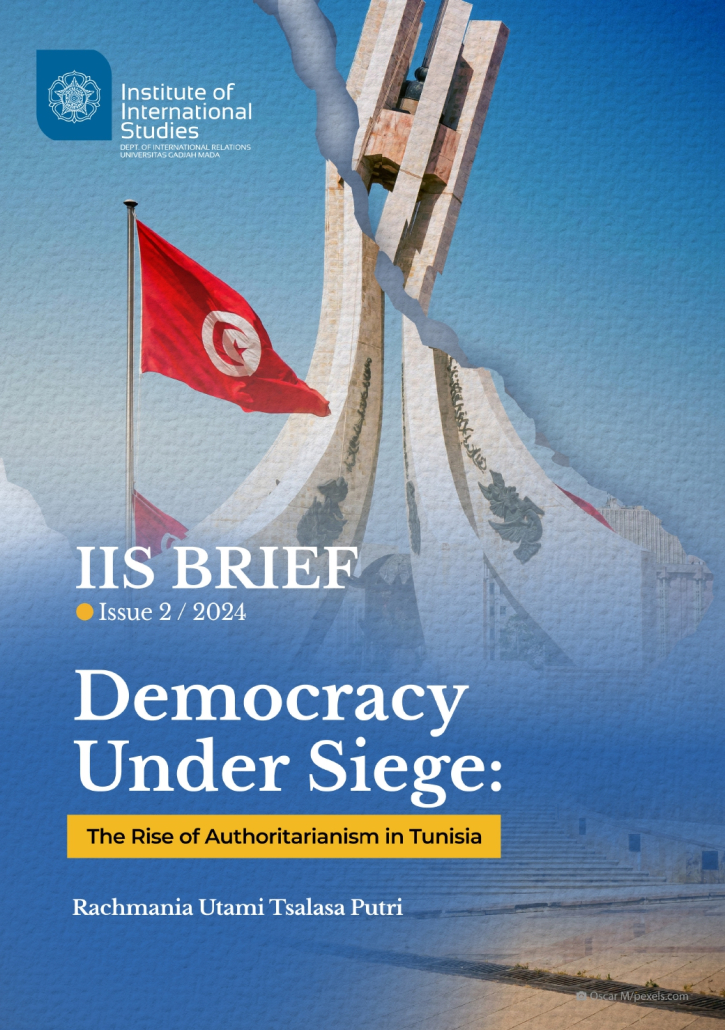
[IIS Brief] Democracy Under Siege: The Rise of Authoritarianism in Tunisia

  • Featured, IIS Brief, News, Publication
  • 7 August 2024, 12.31
  • By : iis.fisipol

[googlepdf url=”https://iis.fisipol.ugm.ac.id/wp-content/uploads/sites/720/2024/08/IIS-Brief_Issue-02-Rachmania.pdf” download=”Download” width=”100%” height=”600″]

The Arab Spring movement in Middle Eastern countries is regarded as a significant catalyst for democratisation in the region. Tunisia emerges as the only country where democratisation has persisted following the Arab Spring. After the impeachment of President Zainal Abidin Ibn Ali in 2011, Tunisia embarked on a process of democratisation, marked by the implementation of democratic presidential elections and a sequence of institutional reforms. Tunisia was deemed successful in achieving democratisation through two peaceful power transfers and fair elections in 2014 and 2019. Nevertheless, the prospect of democratisation in Tunisia is currently diminishing. What is the reason behind this occurrence?

Author: Rachmania Utami Tsalasa Putri
Editor: IIS Team
Designer: Dian Adi MR

Leave A Comment Cancel reply

Your email address will not be published. Required fields are marked *

*

Related Posts

IIS Monthly Review #4 | Edisi August 2025

IIS Fortnightly ReviewIIS Monthly ReviewPublication Friday, 29 August 2025

[googlepdf url=”https://iis.fisipol.ugm.ac.id/wp-content/uploads/sites/720/2025/08/MR-4-August_compressed.pdf” download=”Download” width=”100%” height=”600″]

.

[IIS Commentaries] How Prabowo is Rewriting Indonesia’s Diplomatic Playbook

CommentariesPublication Friday, 15 August 2025

[googlepdf url=”https://iis.fisipol.ugm.ac.id/wp-content/uploads/sites/720/2025/08/Commentaries-Prabowo-Summit-Diplomacy.pdf” download=”Download” width=”100%” height=”600″]

.

[IIS Commentaries] 80 Tahun (Masih) di Bawah Bayang-bayang Ancaman Nuklir

CommentariesPublication Saturday, 9 August 2025

[googlepdf url=”https://iis.fisipol.ugm.ac.id/wp-content/uploads/sites/720/2025/08/Commentaries-Nuklir-80th.pdf” download=”Download” width=”100%” height=”600″]

.

IIS Monthly Review #3 | Edisi July 2025

IIS Fortnightly ReviewPublication Friday, 1 August 2025

[googlepdf url=”https://iis.fisipol.ugm.ac.id/wp-content/uploads/sites/720/2025/08/MR-3-July.pdf” download=”Download” width=”100%” height=”600″]

.
Universitas Gadjah Mada

Institute of International Studies, Universitas Gadjah Mada

Faculty of Social and Political Sciences
Universitas Gadjah Mada
Jl. Sosio-Justisia No.1 Bulaksumur
Yogyakarta 55281, Indonesia

Phone:
+62-274-563362 Ext. 115

E-Mail:
iis.fisipol@ugm.ac.id

© Universitas Gadjah Mada